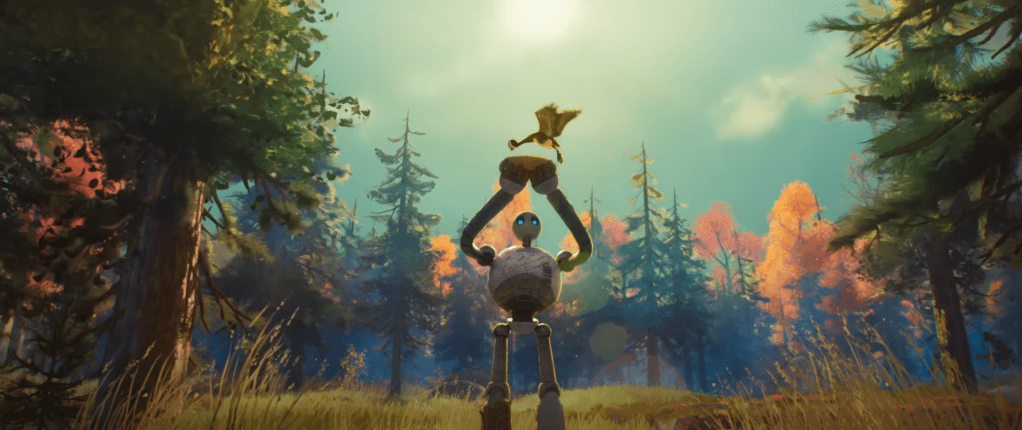
I am happy to report that after being excited for Dreamworks’ The Wild Robot for over six months, I wasn’t disappointed. The story of the robot Roz navigating an unfamiliar island and taking care of a gosling along the way was simple, but told with passion and sincerity in every aspect.
There’s so much to unpack from the film in the thematic department: motherhood, othering, belonging, kindness, communication, technology, the brutality of nature. Death lurks around every corner as Roz tries to survive and keep the runt gosling Brightbill alive on this island where it’s eat or be eaten. Despite the danger, there is beauty and something inspirational in this world that I can’t stop thinking about.
Spoilers for The Wild Robot, the movie.
The world is harsh but beautiful
Not only does The Wild Robot take place on a future earth, but it’s an earth that has gone through extreme climate change. One of my absolute favorite shots of the film is of whales swimming over a flooded Golden Gate Bridge. A few other shots show flooded cityscapes. Such a drastic shift in sea level rise implies one of the worst case scenarios of climate change: the complete melting of polar ice sheets.
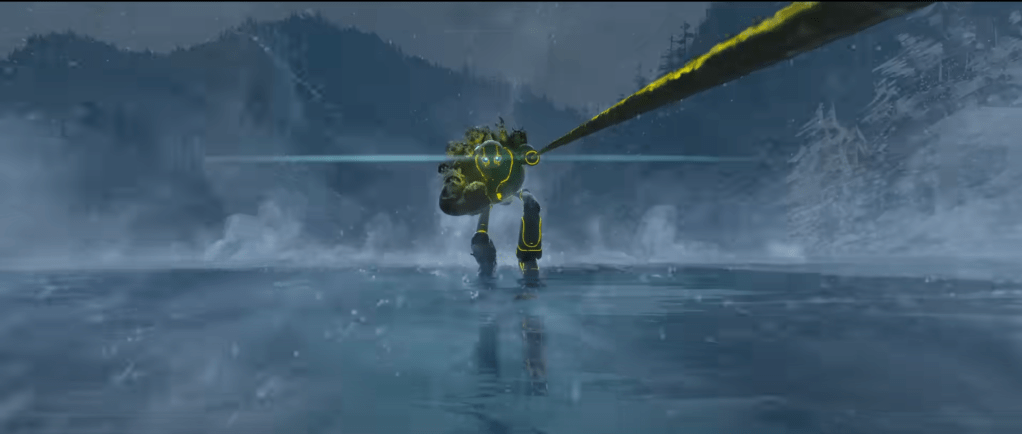
This world likely saw the loss of all coastal cities, massive shifts in seasons and temperatures, and extreme weather events. The climate extremes continue, as shown when the island of the movie’s setting is hit with an especially severe snowstorm. The unpredictable strength of the blizzard is implied from Fink’s description of it as “the worst [he’s] ever seen.”
Humans have also survived though we barely appear in the movie, regulated to a few background models. But it’s clear that we’ve retreated to technologically advanced cities. In addition to development in robotics, there also seems to be strong strides in renewable energy, as Roz spends most of the movie running on her solar power system. Agriculture seems to be a ROZZUM task, with human overseers, in a greenhouse dome completely shielded from the elements.
The point is, despite the hostile environmental changes, we have endured. And so has nature.
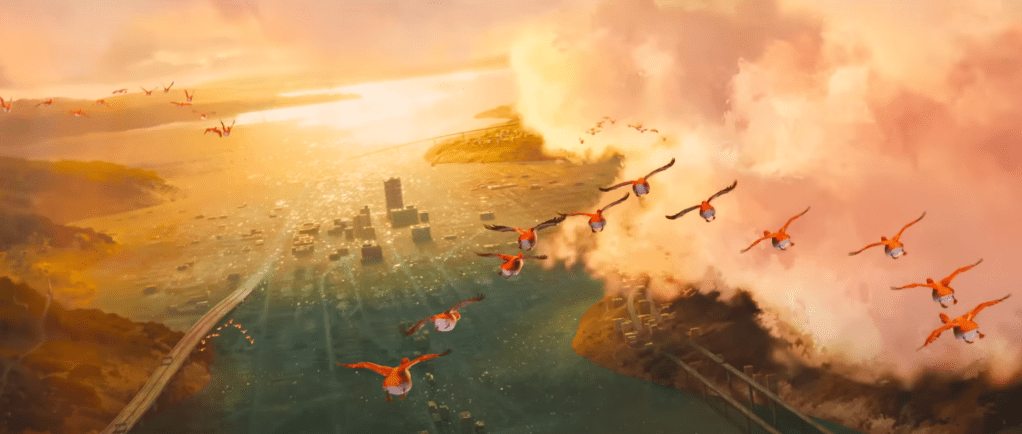
That’s not to say we shouldn’t aim to preserve as much of our modern ecology as we can, but also that climate change isn’t a life-ending apocalypse that will leave the earth cracked and scorched and devoid of life. Considering the changes in the wider world of The Wild Robot, it’s likely that there has been ecological devastation not shown in the film, but some things have stayed the same.
Including a brutal food chain. This movie has a body count, and I laughed at a lot of them. The humor conveys that this is just how the world is. Young ones die, crabs are plucked and eaten alive, Brightbill almost ended up inside a pike’s stomach (or maybe it was a muskie, I am no fish expert). If something isn’t eaten, the weather and perils of other annual processes, like migrations, could still kill.
And yet, nature’s beauty is shown in every frame on the island in the gorgeous impressionist strokes and colors. It’s in the sheer basalt cliffs, the sweeping forests of the island, butterflies taking flight from a tree trunk–as well as in kindness and community.
Brightbill survives despite his small size not only from personal determination, but also the support he was given by those who cared for him. He is cared for by Roz and Fink, given guidance by a peregrine falcon, and protected by the elder goose Longneck. When Brightbill returns from the migration, the geese celebrate him for being a hero. And we celebrate as the audience, knowing the road it took to get there.
Existing together
The film isn’t as simple as nature vs. technology, or “nature good, tech bad”, since Roz ultimately finds herself at home with the animals and they accept her into their community. Her more technical approach to flying is also what helps Brightbill fly.
The animals on the island are terrified of Roz because of unfamiliarity. Once Roz rescues many animals from a brutal freezing death, they come to see her as one of their own.
Like how the high-tech Roz is out of place on the wild island, the migrating geese are out of place in human society. Brightbill and company take shelter in one of the human greenhouses, only to be seen as pests. The other geese panic and struggle to find their way through. But it’s Brightbill, with knowledge of both flight and robotics programming, who leads the geese to safety. While the natural world and technology can come into conflict, they can also complement each other.
If there’s anything Roz and the animals fight against, it’s the corporation Universal Dynamics. This is the company that made Roz and are now hellbent on retrieving her for her adaptive data, completely uncaring of the damage they inflict on the natural world as a result. The film has shown that technology and nature can co-exist…but not if one disregards the other. Though, getting to that place of sharing a space can be difficult.
Overcoming our worst instincts
Roz’s robotic customer service mindset reflects an approach that most of the animals don’t follow: helping others. It’s an early display of what becomes Roz’s characteristic kindness, a trait that Fink the fox makes fun of her for. Most of the animals on the island stick to their own kind or families, and shun what is different. Distrust of predators is certainly understandable, since they could very well be safety risks.
But that instinct to be distrustful of others can be harmful given different circumstances. After Roz and Fink rescue animals from an extreme snowstorm, everyone starts fighting one another in Roz’s shelter and all the risk she put herself through threatens to be all for nothing. Thankfully, Fink’s speech and a plea from Roz pulls the animals to their senses. A truce is called, starting with the grumpy grizzly bear that everyone fears.
As the animals put aside their distrust and settle down, Roz powers down. Surrounded by wooden walls and a warm fireplace, they make it to spring.
It’s easy to choose fear and distrust, to point fingers and assign blame. But as Roz has shown throughout the entirety of the film, sometimes it takes overcoming our instincts–what has been programmed into us–to survive. To think beyond what we are used to, to choose kindness over hostility. That’s how you make it through blizzards.
***
When I went into the theater, I was expecting a visually gorgeous and heartwarming story. But I came home with a lot more ideas to chew on than anticipated. Ultimately, The Wild Robot paints a world that’s both harsh and beautiful. Most importantly, it’s a world where endurance pays off. Where runt goslings can survive difficult migrations, individuals can overcome their worst instincts to persist through disasters, and life–in all of its pains and pleasures–endures.
 Panisara (Por) Jaijongkit